TL;DR: A good magnetic iPhone charger should align cleanly, hold through your normal case, use a PD power source, and avoid adding clutter to your desk or nightstand. For most iPhone 12 and newer users, a simple 15W magnetic wireless puck is the best value. Spend more only if you need a stand, multi-device charging, or premium materials.
A magnetic iphone charger solves two everyday problems at once: you do not have to keep plugging and unplugging a cable, and the charging coil lines up more consistently than it does on a loose flat wireless pad. That matters if you charge at a desk while using the phone, on a nightstand in the dark, or while traveling with one compact accessory.
The catch is that magnetic chargers vary a lot. Some hold firmly; some slide off as soon as you pick up the phone. Some advertise fast wireless charging but need the right PD wall adapter to get there. Others work well only with a thin magnetic case. This guide explains how to judge the details that actually affect daily use, using the same criteria we use when we compare practical phone accessories for desks, travel bags, and bedside setups.
Quick-reference table
| Factor | What to look for | Best choice for |
|---|---|---|
| Magnetic hold | Centered alignment and a secure grip through a compatible case | Using the phone while charging |
| Charging power | Up to 15W output with PD support | Daily iPhone top-ups |
| Heat control | Clean alignment, no bulky obstruction, sensible placement | Nightstand and longer sessions |
| Case compatibility | Thin magnetic case or bare phone for the strongest connection | Reliable everyday charging |
| Form factor | Pad, puck, stand, or folding travel design | Desk, bed, or travel use |
| Cable clutter | Minimal puck design or a weighted stand | Cleaner desktops |
| Price | $10-$20 for basic pucks; $25-$60 for stands; $70-$150+ for premium stations | Matching features to budget |
1. Magnetic alignment and hold
The magnetic part is not just a convenience feature. It is what keeps the wireless charging coils in the right position. Poor alignment wastes energy, creates more heat, and can slow charging. A good magnetic phone charger should snap into place without you hunting for the sweet spot.
For iPhone 12 and newer models, this is the main reason to choose a magnetic wireless charging puck instead of a generic Qi pad. If you are searching for a mag safe charger for iphone 12, an iphone 12 mag charger, or a mag safe charger for iphone 13, the key question is not only whether the charger attaches. It is whether it stays centered when the phone buzzes, shifts on a desk, or gets picked up for a quick message.
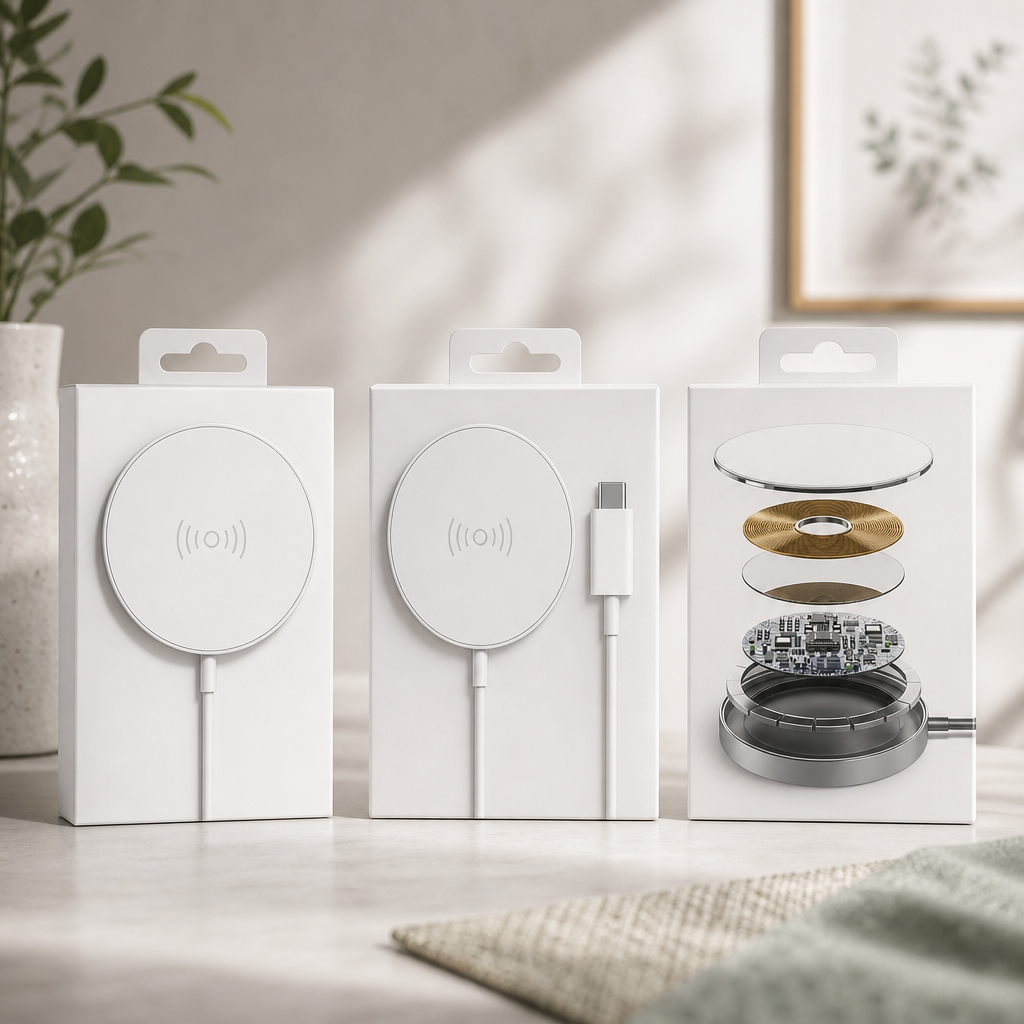
The 15W Magnetic Wireless Charger for MagSafe iPhone uses magnetic wireless alignment and an iPhone-style magnetic charging layout. At 50 g, it is light enough for travel and easy to move between a desk and nightstand, but that also means it behaves like a puck rather than a heavy dock. If you want one-handed phone removal, consider a weighted stand; if you want portability, a light magnetic puck is easier to pack.
2. Real charging power and PD support
Power claims are one of the easiest places to overbuy or misunderstand a magnetic charger. A charger can have a 15W maximum output and still perform poorly if you pair it with a weak wall adapter, a poor cable, a thick case, or misalignment. Judge the whole charging chain, not just the number on the product page.
For a magnetic iphone charger, 15W is the practical ceiling to look for in a simple iPhone-focused puck. The M1 magnetic wireless charger has 15W maximum output, 15W total power, 2A output current, and PD charging protocol support. That combination makes sense for daily top-ups at a desk or overnight use, especially when paired with an appropriate PD power adapter.
Be skeptical of cheap magnetic chargers that emphasize fast charging but do not support a modern power protocol. PD support matters because many current wall adapters and USB-C power setups rely on it to negotiate power properly. If you want a deeper technical explanation of how magnetic wireless charging works, the core idea is simple: magnets help align the coils, while the power protocol and adapter determine how much usable power reaches the charger.
3. Heat management and charging speed
Wireless charging creates more heat than wired charging because power transfers across a small air gap. Heat is not automatically a defect, but excess heat can cause the phone to slow charging to protect the battery. If your magnetic phone charge starts fast and then crawls, heat and alignment are usually the first things to check.
To judge heat performance before buying, look for three practical clues. First, the charger should align reliably so the coil is not offset. Second, it should not bury the phone in a bulky enclosure with poor airflow. Third, the design should fit your use case: a thin puck on a nightstand may be fine for overnight charging, while a raised stand can help if you frequently watch video or take calls during charging.
The M1 charger’s minimal no-display design is an advantage here for many users. A digital display can be useful on some power accessories, but on a nightstand charger it can add light and visual noise. A simple magnetic wireless charging puck keeps the setup clean and avoids unnecessary distractions near the bed.
4. Case compatibility and magnetic strength
Cases are the most common reason magnetic chargers disappoint. A thick case, wallet case, metal plate, pop-out grip, or non-magnetic case can weaken the hold and increase the distance between the coils. That can make the phone slip, charge slowly, or stop charging when bumped.
The best way to judge case compatibility is to think in layers. Bare phone is the strongest connection. A thin magnetic case is usually the best everyday compromise. A thick protective case may still attach, but it can reduce both magnetic grip and wireless charging efficiency. If you like rugged cases, buy from a retailer with a simple return process or choose a charger and case that are clearly designed to work together.
This is especially important if you charge while using the phone. A weak magnet is annoying on a desk, but it is worse when you are holding the phone horizontally, scrolling in bed, or taking a call. If the charger falls away, you lose the main reason to choose magnetic chargers over a normal cable.
5. Form factor for desk, nightstand, and travel
Magnetic chargers come in a few common shapes. A puck is the simplest and most portable. A stand keeps the screen visible and is better for desks. A folding travel charger may add watch or earbud charging. A large station can replace several cables but takes more space and costs much more.
For a desk, choose based on how you use the phone. If you want to see notifications, take video calls, or use standby-style viewing, a stand is more convenient. If you mostly set the phone down between tasks, a puck is cheaper and easier to position. For a nightstand, a low-profile puck is less likely to glow, tip, or crowd the surface. For travel, weight and packability matter more than premium materials.
The 50 g build of the M1 charger makes it a strong fit for travel bags, office drawers, and compact bedside setups. It is not trying to be a multi-device dock or a decorative aluminum stand. It is a simple magnetic wireless phone charger with a clean desktop role: attach the phone, reduce plug wear, and keep the cable situation less messy.
6. Cable clutter and port wear
One of the best reasons to buy a magnetic charger for i phone use is reducing daily wear on the charging port. Every plug-in cycle adds a little mechanical stress, and pocket lint or cable angle can make wired charging more irritating over time. A magnetic charger lets the phone land on the charger instead of being plugged in repeatedly.
It also helps clean up a desk. A single puck can live in one spot, so you are not fishing for a loose cable under a monitor or behind a nightstand. The M1 charger’s neutral, unbranded appearance and no-display design work well in that role. It blends into a workspace rather than looking like another gadget demanding attention.
If cable clutter is your main complaint, avoid buying a large charging station unless you truly need to charge multiple devices at once. A simple magnetic charging phone setup can be cleaner than a premium dock if it matches your actual routine.
7. Device compatibility and ecosystem fit
For iPhone shoppers, the cleanest fit is an iPhone with built-in magnetic charging support, especially iPhone 12, iPhone 13, and newer models. A magsafe charger for iphone 12 or magsafe charger for iphone 13 should align directly with the phone’s magnet ring or with a compatible magnetic case. Older iPhones can use wireless charging, but they may need a magnetic case or adapter ring to get the same snap-on behavior.
The M1 charger is a neutral, unbranded magnetic wireless charger, not an original Apple accessory. That matters if you specifically want the official model, but for buyers who care more about price, portability, and basic 15W magnetic wireless charging, a well-matched third-party puck can be the better value.
Android shoppers should be more careful. Some Android phones support wireless charging but do not have the same built-in magnetic layout. If you came in searching for a samsung magnetic charger, focus on whether your phone or case has a compatible magnetic ring and whether the phone supports wireless charging. Magnets and wireless charging can work together well, but the magnet layout has to match the phone and case.
Common mistakes to avoid
Buying on wattage alone. A big power number does not guarantee faster charging. Look for PD support, clean alignment, and a realistic output such as 15W for an iPhone-focused puck.
Ignoring the case. If your case is too thick or lacks a magnetic ring, the charger may feel weak or charge inconsistently. Case compatibility is just as important as charger quality.
Using the wrong wall adapter. A magnetic charger with PD support should be paired with a PD power source. Reusing an old low-power adapter can make a good charger feel slow.
Expecting a puck to act like a dock. A light puck is portable and affordable. A stand is better if you want one-handed removal or an upright screen.
Buying a bright bedside charger. Displays and LEDs can be annoying at night. A minimal no-display charger is often better for a nightstand.
Assuming all magnetic chargers fit all phones. Magnetic wireless charging depends on phone support, case design, and coil alignment. Check the phone-and-case combination, not just the charger.
Price expectations
Budget: $10-$20. This tier is where simple magnetic pucks make the most sense. Expect a compact design, basic packaging, and one-device charging. The 15W Magnetic Wireless Charger for MagSafe iPhone sits squarely in this range at $10.99, with 15W maximum output, PD protocol support, magnetic alignment, a 50 g build, and no digital display. For most buyers who want a low-cost magnetic iphone charger for a desk, nightstand, or travel pouch, this is the value tier to start with.
Midrange: $25-$60. This range usually adds better materials, heavier bases, upright stands, folding travel designs, or bundled cables and adapters. It is worth paying more if you want one-handed use at a desk, a more stable nightstand base, or a charger that props up the phone for viewing.
Premium: $70-$150+. Premium magnetic chargers are usually multi-device stations, higher-end stands, or travel kits that charge a phone plus other accessories. They can be worth it if they replace several separate chargers. They are overkill if you only need one reliable magnetic phone charger for your iPhone.
Our recommendation is straightforward: choose a budget 15W magnetic puck if you want simple, portable charging; move to a midrange stand if the phone must stay visible and easy to remove; pay premium prices only when multi-device charging or high-end materials solve a real space problem.
Related Guides & Products
- phone-accessories — Top Picks
- How Magnetic Wireless Charging Works
- 15W Magnetic Wireless Charger for MagSafe iPhone
Frequently Asked Questions
Is 15W enough for iPhone charging?
Yes. For a magnetic iPhone charger, 15W is a practical target for everyday top-ups and overnight charging when paired with an appropriate PD power source.
Will a thick case weaken the magnet?
Yes. Thick, non-magnetic, wallet, or metal-plate cases can reduce magnetic hold and charging efficiency. A thin magnetic case is usually the safer choice.
Is a puck or stand better?
Choose a puck for travel, low cost, and simple nightstand use. Choose a stand if you want the screen visible or easier one-handed removal.
Why does wireless charging slow down?
Heat, poor alignment, a weak wall adapter, or a thick case can slow wireless charging. Magnetic alignment and PD support help reduce common speed issues.
Can magnetic charging reduce port wear?
Yes. Because you are not repeatedly plugging and unplugging a cable, magnetic wireless charging can reduce daily mechanical wear on the phone’s charging port.
What should a budget charger cost?
A basic one-device magnetic puck should usually cost about $10 to $20. Stands and multi-device stations cost more because they add structure and features.