TL;DR: The best portable water flosser for most small bathrooms should balance adjustable pressure, a tank that does not force constant refills, a waterproof body, and enough battery life for travel. Choose the IPX7 cordless model if you want the strongest all-around spec mix, the A8 if weight and price matter most, and the T956 if tonsil-stone cleaning is your main reason to buy.
A portable water flosser is the right dental irrigator when string floss feels awkward, food sticks around braces, or your bathroom counter cannot spare room for a full-size unit. We researched and compared cordless models by the specs that actually affect daily use: pressure control, tank size, battery capacity, waterproofing, nozzle fit, cleaning access, and travel weight. For a broader oral-care shopping shortlist, see our vetted oral-care picks.
If you are comparing a cordless pick with a Waterpik countertop dental irrigator, the trade-off is straightforward: countertop models usually prioritize reservoir size and steady home use, while a cordless water flosser prioritizes portability, drawer storage, and travel convenience. For small bathrooms and trips, the cordless format is often the more practical choice.
Quick-reference table
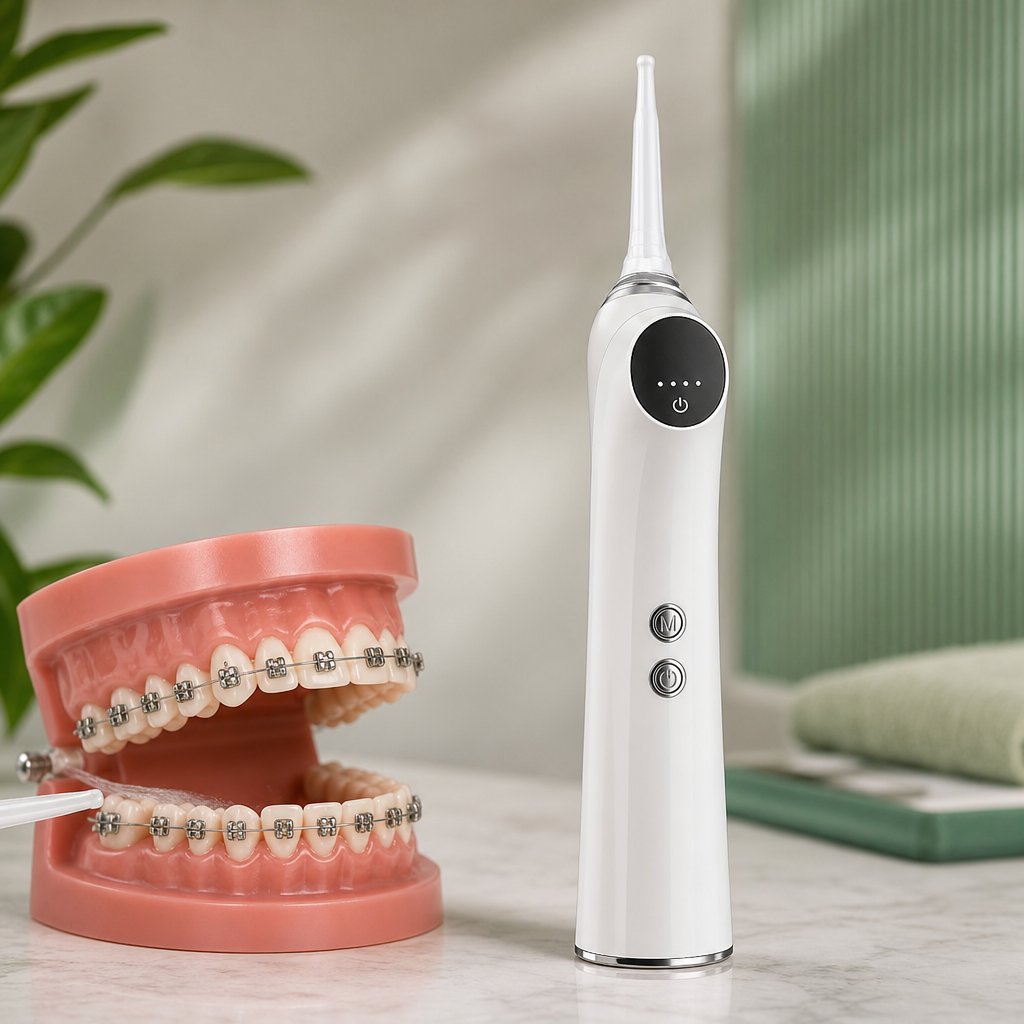
| Need | What to look for | Best fit from these options | Typical price |
|---|---|---|---|
| Lowest-cost daily cleaning | Light body, rechargeable battery, basic water resistance | A8 Portable Cordless Water Flosser | $24.99 |
| Best all-around travel setup | IPX7 body, larger battery, multiple modes, larger-tank variant | Portable Cordless Water Flosser with IPX7 Waterproofing | $29.99 |
| Tonsil-stone-focused cleaning | Handheld irrigator format, targeted cleaning, adult use | T956 Portable Oral Irrigator | $36.99 |
| Braces and tight gaps | Adjustable cleaning modes, stable nozzle fit, controlled technique | IPX7 cordless model or T956 | $29.99-$36.99 |
| Small sinks and shared bathrooms | Leak-resistant design, waterproof body, easy drying | IPX7 cordless model | $29.99 |
1. Pressure control matters more than maximum force
The biggest comfort problem with any water flosser is pressure that lands at the wrong end of the scale. Too strong, and it can irritate sensitive gums. Too weak, and it leaves food trapped between teeth, under wires, or around brackets. The safest way to judge a portable water flosser is not by chasing the most aggressive jet; it is by checking whether the unit gives you usable steps.
The Portable Cordless Water Flosser with IPX7 Waterproofing is the strongest all-around choice here because it supports three cleaning modes or three-level adjustment depending on the variant, and it uses a piston pump water jet. That gives you room to start gently and move up as your gums adapt. The A8 also uses a piston pump, which is a good sign for a focused water stream in a compact oral irrigator. For tonsil stone cleaning, gentle control is especially important because the goal is targeted rinsing, not blasting soft tissue.
How to judge it: choose adjustable modes if you have sensitive gums, braces, implants, or deep gaps that trap food. If you are new to water picking, start with the gentlest mode and aim along the gumline rather than straight into the gum pocket.
2. Tank capacity decides whether daily use feels convenient
A tiny reservoir can turn a simple routine into a stop-start chore. If you are mainly cleaning the front teeth, a smaller tank may be fine. If you have braces, wide spacing, or want to irrigate the full mouth carefully, a larger tank is easier to live with. The IPX7 cordless model has large-tank variants with more than 400 mL capacity, which is generous for a cordless portable water flosser. It also has a continuous-water tankless option on some variants, which can help if you dislike refilling mid-clean.
The A8 Portable Cordless Water Flosser keeps its water tank under 300 mL. That smaller tank is part of why the unit stays light at 250 g net weight, but it also means you should expect more frequent refills during a full-mouth clean. For travel, that trade-off can make sense. For a permanent bathroom tool used by someone with braces, a larger-tank variant is usually more satisfying.
How to judge it: under-300 mL tanks are best for travel, quick rinses, and minimal storage. Tanks above 400 mL are better for full-mouth cleaning, braces, and users who hate pausing to refill.
3. Battery capacity and runtime affect travel reliability
A travel dental flosser should not need constant charging. Both cordless options here use built-in rechargeable batteries, but their capacity ranges differ. The A8 uses a 500-800 mAh battery and runs for more than 15 days. That is enough for short trips and simple daily use. The IPX7 cordless model uses a 1200-2000 mAh battery and runs for more than 30 days, making it the better pick for longer travel, shared use, or anyone who forgets to charge grooming devices.
Weight matters too. The A8 is the easiest to pack at 250 g net weight and 330 g gross weight. The IPX7 cordless model weighs 347 g, still reasonable for a toiletry kit while offering a bigger battery and larger-tank options. The T956 weighs 500 g, so it is portable in a handheld sense but less ideal if every ounce in your travel bag matters.
How to judge it: for weekend trips, a smaller battery is fine if the unit is light. For two-week travel, shared bathrooms, or daily braces cleaning, prioritize the larger battery and longer runtime.
4. Waterproofing, leaks, and drying should shape your choice
Water flossers live in a wet environment, so waterproofing is not a luxury feature. It affects sink use, shower-adjacent storage, cleaning, and long-term hygiene. The IPX7 cordless model has the stronger waterproof rating among the two cordless flossers here. The A8 carries IPX6 waterproof protection, which is still a useful level for splash-heavy bathroom use.
Leaks and loose nozzles are common complaints with inexpensive oral irrigators. Specs alone cannot promise perfect fit, but you can reduce risk by favoring a well-integrated cordless body, checking that tips lock firmly before filling the tank, and emptying the reservoir after use. Mold risk usually comes from leaving water sealed inside the tank or storing the device wet in a dark bag. A fragrance-free product like the T956 keeps the cleaning experience neutral, but any oral irrigator still needs draining and air-drying.
How to judge it: choose IPX7 if you want the more forgiving waterproof body. Choose IPX6 if you are prioritizing price and weight but will keep the unit drained and dried after use.
5. Nozzles and use case matter for braces, gaps, and tonsil stones
Food stuck between teeth and around braces is one of the best reasons to buy a portable water flosser. A focused stream can reach around brackets and wires more easily than string floss alone. The IPX7 tankless three-mode variants include four nozzle tips, which is useful for households, replacement rotation, or keeping one tip dedicated to travel. The A8 comes with interchangeable nozzle options depending on the selected quantity.
The T956 is the most purpose-specific option. The T956 Portable Oral Irrigator is built around targeted oral cleaning and a tonsil-stone-focused use case, while also being useful around braces. At 500 g, it is heavier than the two cordless water flossers, but that weight may be acceptable if your main goal is careful tonsil stone water flosser use rather than ultralight travel.
How to judge it: for braces, prioritize adjustable flow and stable tips. For tonsil stones, prioritize targeted control and gentle technique. A water flosser for tonsil stones should be used carefully; aim to rinse and loosen debris, not scrape or force tissue.
6. Size, grip, and bathroom storage are everyday deal breakers
Small bathrooms punish bulky devices. A portable water flosser should stand or store easily, fit near a compact sink, and not feel slippery when wet. The A8 has the clearest advantage for tight storage because of its 250 g net weight and under-300 mL tank. It is the model to consider if you want a cordless water flosser that disappears into a drawer or travel pouch.
The IPX7 cordless model is slightly heavier at 347 g, but the added weight buys you stronger battery capacity, more runtime, and larger-tank options. That is the better compromise for a primary home-and-travel device. The T956, at 500 g, is better viewed as a targeted portable oral irrigator than a minimalist toiletry-kit item.
How to judge it: if the device will live in a suitcase, pick the lightest body you can tolerate. If it will live by the sink and travel occasionally, accept a little more weight for a better tank and battery.
7. Cleaning modes should match gum sensitivity
Many shoppers buy a water flosser after realizing string floss is uncomfortable or inconsistent. That does not mean the strongest setting is the right setting. Sensitive gums need a gradual ramp-up. The IPX7 cordless model’s three modes or three-level adjustment make it the easiest of these options to recommend for users who want flexibility. The A8 is better for budget buyers who want a simple piston-pump oral irrigator and are comfortable with a smaller tank and shorter runtime.
For braces, technique matters as much as hardware. Angle the stream along the gumline and around each bracket, pausing where food collects. Do not jam the tip against tissue. If you are buying primarily as a flosser for braces, choose a model with multiple tips or easy tip replacement so the nozzle stays clean and firm over time.
How to judge it: if your gums bleed easily or feel sore after flossing, choose the model with more adjustment range. If your gums are healthy and your priority is removing visible food quickly, a simpler budget model can be enough.
Common mistakes to avoid
Buying only for pressure. Stronger is not automatically cleaner. Comfort and consistency matter more, especially for sensitive gums and tonsil areas.
Ignoring tank size. A compact tank is great for travel but annoying for braces if you need to refill before finishing your mouth.
Letting water sit in the reservoir. Empty the tank after use, run a short burst to clear the nozzle, and let the body dry before storing it. This helps reduce musty smells and mold risk.
Using one nozzle for everything. If multiple people share a unit, each person needs a separate tip. If one person uses the device for tonsil stone cleaning and tooth cleaning, separate tips are more hygienic.
Assuming a portable model replaces brushing. A water flosser is a supplement to brushing and regular flossing habits. It helps rinse debris from gaps, braces, and gumline areas, but it does not scrub tooth surfaces like a toothbrush.
Packing it full of water. For travel, empty the tank and dry the cap area before putting the unit in a toiletry bag. This reduces leaks and keeps the body cleaner.
Price expectations: what you get at each tier
Budget: $20-$30. This tier is where the A8 at $24.99 fits best. Expect a compact cordless oral irrigator with a built-in rechargeable battery, lighter body, basic waterproofing, and a smaller tank. It is the right range for first-time buyers, dorm bathrooms, guest bathrooms, and travelers who want a dental flosser without spending much.
Mid-range: $30-$45. This is the sweet spot for most buyers. The IPX7 cordless model at $29.99 sits just under the tier but delivers mid-range advantages: IPX7 waterproofing, a 1200-2000 mAh battery, more than 30 days of runtime, multiple cleaning modes, and large-tank variants over 400 mL. The T956 at $36.99 also belongs here because its value is more specialized: targeted cleaning for adults, tonsil-stone-focused use, and usefulness around braces.
Premium portable: $45-$80. In this range, shoppers should expect a more polished cordless water flosser experience: better accessory sets, more refined controls, stronger travel cases, larger reservoirs, or more premium finishes. If a premium model still has a tiny tank, limited adjustment, or unclear waterproofing, it is hard to justify paying more.
Countertop and advanced home units: $70-$120. These are less convenient for travel and small bathrooms, but they can make sense for families or people who want a large reservoir and a permanent sink setup. For most travelers, renters, and small-bathroom shoppers, a cordless portable water flosser in the $25-$40 range is the better buy.
Our recommendation is simple: pick the IPX7 cordless model if you want one water flosser for home and travel; pick the A8 if you want the cheapest credible cordless option with a light body; pick the T956 if tonsil stone cleaning is the core job. Those three use cases cover most buyers without overspending.
Related Guides & Products
- oral-care — Top Picks
- Best Portable Water Flosser Guide for Travel
- How to Use a Water Flosser for Braces
- Water Flosser for Sensitive Gums: Comfort Guide
- Water Flosser for Tonsil Stones: Safe How-To
- Waterpik Water Flosser vs Cordless Picks
- Which Dental Irrigator Should You Buy?
- Cordless Water Flosser Review: IPX7 Portable Pick
- T956 Oral Irrigator Review for Tonsil Stones
- A8 Portable Oral Irrigator Review: Budget Pick
- How Often to Use a Water Flosser: Daily Care Guide
- Can You Use Mouthwash in Water Flosser?
- Water Flosser vs Floss: Which Cleans Better?
- T956 Portable Oral Irrigator for Tonsil Stone Cleaning
- Portable Cordless Water Flosser with IPX7 Waterproofing
- A8 Portable Cordless Water Flosser with IPX6 Waterproofing
Frequently Asked Questions
Is a portable water flosser good for braces?
Yes. A portable water flosser can rinse food around brackets and wires more easily than string floss alone. Choose adjustable pressure and use a gentle angle along the gumline.
What tank size is best for travel?
Under 300 mL is easier to pack and lighter. Larger tanks over 400 mL are better for full-mouth cleaning and braces because they reduce refills.
Can it help with tonsil stones?
A targeted oral irrigator can help rinse and loosen tonsil debris. Use gentle pressure and avoid forcing the stream directly into sensitive tissue.
Is IPX7 better than IPX6?
IPX7 is the stronger waterproof rating and is more forgiving around wet sinks. IPX6 is still useful for splash-heavy bathroom use when the unit is drained and dried.
How much should I spend?
Most buyers should expect $20-$30 for budget cordless models, $30-$45 for better batteries or specialty use, and $45-$80 for premium portable designs.
Which model is best for long trips?
The IPX7 cordless model is the strongest travel pick here because it has a 1200-2000 mAh battery and more than 30 days of runtime.
This article is for general information only and is not medical or dental advice. Consult a licensed dentist or doctor for any health concern.