TL;DR: A large slow feeder bowl should slow your dog without frustrating them. Look for a wide, shallow maze, anti-slip base, and easy-clean material. Stainless steel 304 resists odors and corrosion; PP is lighter and cheaper. Budget $15-$25, mid $25-$45, premium $45+.
Dogs that eat too fast often choke, gag, vomit, or develop gas because they swallow air with each bite. A dog slow feeder bowl large enough for your dog’s muzzle turns an inhale-and-go meal into a puzzle the dog has to work around, naturally pacing the meal. We vetted and compared current options across materials, sizes, and price points. For small to medium dogs, our top picks are the 18 cm stainless steel slow feeder bowl and the square PP slow feeder dog & cat bowl. For the full set of picks, see our best dog slow feeder bowls roundup.
Size and Depth: What “Large” Actually Means
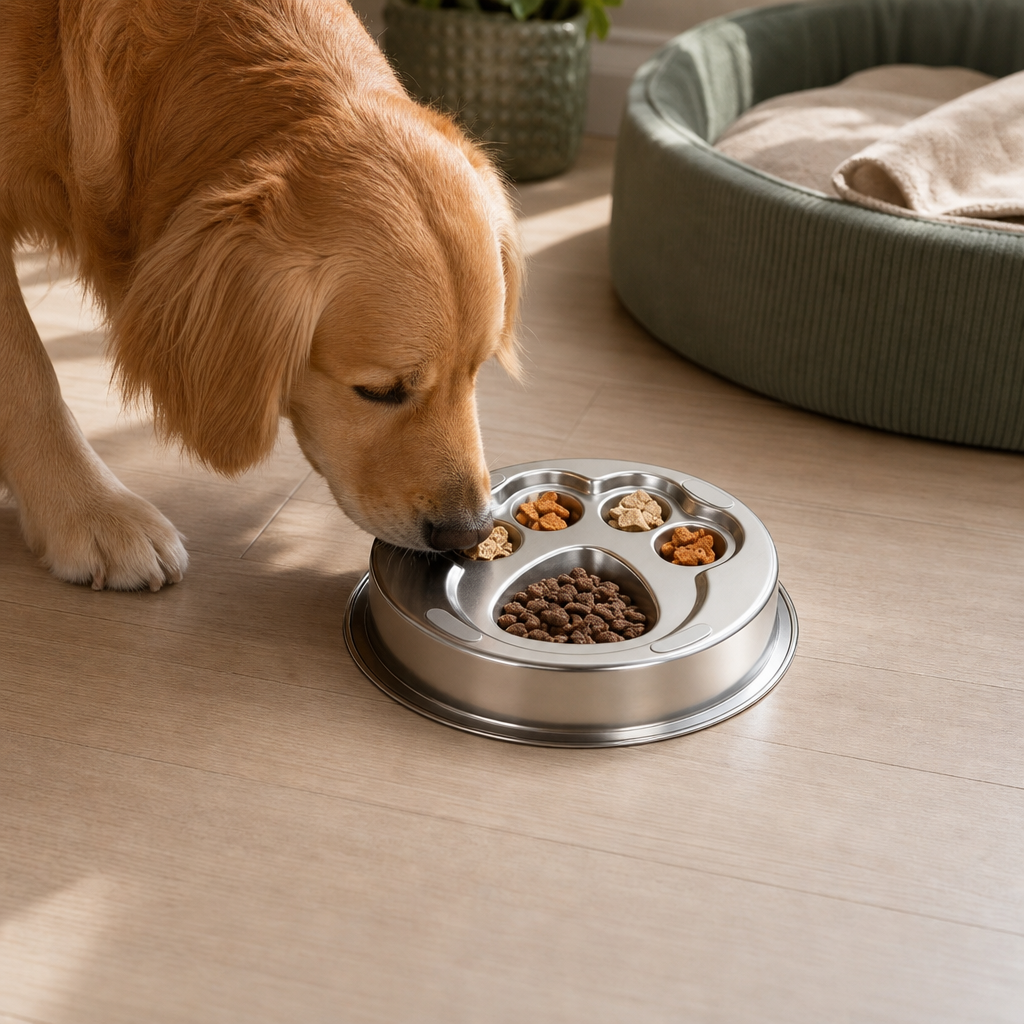
For a large breed, “large” means more than a label. The bowl’s footprint must be wide enough for a broad muzzle, and the eating surface must be deep enough to hold a full meal without forcing the dog to work at an awkward angle. The 18 cm stainless steel model we vetted measures 18 cm across (about 7 inches) and weighs 150 g, which fits cats, puppies, and small to medium dogs. If you own a Labrador or shepherd, scale up. Look for a bowl at least as wide as your dog’s muzzle plus a couple of inches on each side; many large dogs do better with a diameter of 9 inches or more.
Depth is the hidden gotcha. A maze with tall, narrow pockets may look challenging, but a short-nosed or flat-faced dog can find it impossible to lick the bottom. Shallow, wide channels work better. The square PP option has a 19 × 19 cm footprint in its retail box, and its square shape slows eating without relying on extreme depth. A bowl that slows eating by making food slightly harder to reach is better than one that frustrates your dog. Some large dogs also have longer tongues, so a slightly deeper but still wide bowl can work if the grooves are spaced far enough apart.
Material: Stainless Steel vs. PP Plastic
The two materials that matter most here are stainless steel and PP plastic. Stainless steel wins on durability and hygiene. The 18 cm stainless steel dog slow feeder bowl comes in 304 and 201 stainless options. 304 stainless is the more corrosion-resistant choice, so it is the one we recommend if your dog eats wet food or you wash the bowl daily. The feeding surface is stainless, and at 150 g it is heavy enough to sit still on smooth floors.
PP plastic is lighter and often cheaper. The square PP slow feeder dog & cat bowl weighs 230 g and comes in black and blue. PP is food-safe and generally durable, but it can scratch over time, and oily food can cling to scratched grooves if you do not rinse it right after meals. For large dogs that tend to shove the bowl across the floor, a heavier stainless bowl or a weighted plastic design usually works better than a featherweight plastic tray. The 201 stainless option is more budget-friendly but less resistant to pitting from acidic foods, so 304 is our pick for daily use.
Quick reference for what to check:
| Factor | What to Look For | Vetted Options |
|---|---|---|
| Size & depth | Wide enough for muzzle, shallow enough for flat-faced dogs | 18 cm stainless (small) / 19 cm square PP |
| Material | 304 stainless for durability; PP for lightweight budget | 18 cm stainless bowl / square PP bowl |
| Pattern | Wide, rounded ridges; avoid deep narrow pockets | Bone, paw, fishbone patterns on stainless |
| Stability | Anti-slip base or weighted square shape | Both models include anti-tip/anti-spill design |
| Cleaning | Non-porous surface, easy to reach grooves | Stainless rinses clean; PP wipe down |
| Price | Budget $10-$25; mid $25-$45; premium $45+ | $15.99 PP, $20.99 stainless |
Maze and Pattern Design: Slowing Without Frustration
Not all puzzle patterns are equal. The stainless model offers bone, dog paw, bear paw, and fishbone patterns. These are not just decorative; the raised ridges force the dog to eat around obstacles, pacing the meal. When you evaluate a dog slow feeder bowl, look for patterns with wide, rounded ridges rather than sharp, deep pockets. Sharp edges can frustrate a dog and may be less comfortable for flat-faced breeds. For more detail on how different maze layouts affect pacing, see our puzzle and maze bowl buyer’s guide.
The square PP bowl uses its anti-spill square shape as part of the slowing mechanism. The corners slow the dog’s approach to food without relying solely on tall dividers. That can be a good match for dogs that get frustrated by intricate spiral mazes.
Stability: Anti-Slip and Anti-Tip Geometry
A bowl that slides across the floor while your dog eats doesn’t slow anything; it just moves the mess. We looked for anti-slip and anti-tip design features in every option we vetted. The stainless model explicitly includes an anti-slip bowl design and an anti-tip everyday bowl construction, which helps on tile, hardwood, and smooth mats. The square PP bowl’s shape also resists tipping, and its flat base keeps it from pivoting when a dog pushes against it. For large dogs, prioritize a wide, low-profile base with a non-skid bottom. If the bowl you choose lacks it, a silicone mat underneath can help, but a built-in anti-slip base is cleaner and less likely to move. An anti-tip bowl with a low center of gravity is especially useful for enthusiastic eaters.
Cleaning and Hygiene: Daily Drag vs. Dishwasher
Grooves and ridges add the slow-down effect, but they also trap food residue. Stainless steel is the easiest material to wipe down and is non-porous, so it does not hold onto oils or odors the way some plastics can. The stainless bowl’s smooth feeding surface means a quick scrub with warm, soapy water is usually enough. PP is also straightforward to clean, but because it is plastic, you should avoid abrasive scrubbers that leave scratches. If you feed wet or raw food, rinsing the bowl immediately after meals prevents residue from drying in the crevices. Regular cleaning also prevents bacterial buildup in moist crevices. For anyone weighing material trade-offs, a stainless bowl generally wins on long-term hygiene, while PP wins on weight and price.
Price Expectations: Budget, Mid, Premium
In this category, you can find a solid dog slow feeder bowl large enough for many small to medium dogs for under $25. The square PP bowl is $15.99, and the 18 cm stainless steel model is $20.99. Both sit firmly in the budget tier. For larger breeds or heavy-duty materials, expect to move into the mid tier of $25 to $45, where you start seeing larger diameter stainless bowls, more complex maze patterns, and reinforced non-slip bases. The premium tier runs $45 to $80 or more, typically for large ceramic or thick 304 stainless designs with higher weight and larger capacity. If your dog is over 60 pounds, budget for the mid or premium range; a truly large footprint and a heavy base tend to cost more.
Common Mistakes When Buying a Large Slow Feeder Bowl
One common mistake is buying a “large” bowl based on the marketing name rather than the actual diameter. Always check the listed size in centimeters or inches. Another is ignoring depth: a deep, narrow maze may be fine for a long-snouted dog but useless for a pug or bulldog. Skipping the anti-slip base is a close third, especially with large dogs that eat with force. Some people assume all plastic bowls are the same, but thin PP can flex and crack, while 304 stainless resists rust. Finally, do not overlook cleanability. A bowl with dozens of tiny crevices may slow eating but will become a chore to wash. If your dog tends to knock bowls around, a wider base and more weight matter more than extra pattern complexity. Consider buying two bowls if you feed multiple meals a day so one can dry while the other is in use.
Related Guides & Products
- dog slow feeder bowls — Top Picks
- Small Slow Feeder Dog Bowl Buyer’s Guide
- How to Use Dog Bowls for Fast Eaters Safely
- Puzzle and Maze Dog Bowl Buyer’s Guide
- Best Slow Feeder Dog Bowl: Stainless vs PP
- Can You Use a Slow Feeder Dog Bowl for Wet Food?
- 18 cm Stainless Steel Slow Feeder Dog Bowl Review
- Square PP Bowl for Dogs to Slow Eating Review
- Slow Water Bowl Dog Buyer’s Guide
- Ceramic Slow Feeder Dog Bowl Buyer’s Guide
- Slow Eating Dog Bowl for Small Dogs: Buyer’s Guide
- Puppy Slow Feeder Buyer’s Guide
- Anko Pet Slow Feed Bowl () Reviews
- Slow Feeder Dog Bowl Buyer’s Guide
- Slow Feeder Dog Bowl Guide: Stainless & PP Picks
- Fun Feeder Slo Bowl Buyer’s Guide
- Slow Feeder Buyer’s Guide: Stainless & PP
- Slow Feeder Dog Bowl Buyer’s Guide: Stainless & PP
- Fun Feeder Dog Bowl Buyer’s Guide
- Dog Interactive Feeder Buyer’s Guide
- 18 cm Stainless Steel Slow Feeder Dog Bowl
- Square PP Slow Feeder Dog & Cat Bowl
Frequently Asked Questions
What size slow feeder bowl is best for a large dog?
Choose a bowl with a footprint at least as wide as your dog’s muzzle plus extra room, and shallow enough for easy licking. Large breeds need wider, heavier bowls; small 18 cm models may not hold enough food.
Is stainless steel or plastic better for slow feeder bowls?
Stainless steel, especially 304, is more durable, non-porous, and easier to sanitize. PP plastic is lighter and cheaper but can scratch and retain odors over time. For large dogs, stainless often resists tipping better.
How do I clean a dog slow feeder bowl?
Rinse it immediately after meals, then scrub with warm, soapy water. Stainless steel can handle a non-abrasive sponge. Avoid harsh scrubbers on PP plastic to prevent scratches where food residue can hide.
Can a slow feeder bowl prevent bloat?
Slowing eating can reduce air gulping and the risk of bloat, but no bowl is a guarantee. Portion control, avoiding exercise after meals, and using a bowl that paces eating all help.
How much should I spend on a large slow feeder bowl?
Budget options run $10 to $25. Mid-tier bowls with larger diameter and heavier bases are $25 to $45. Premium large ceramic or thick stainless designs often cost $45 to $80 or more.
What if my dog has a flat face?
Choose a slow feeder bowl with shallow, wide channels rather than deep, narrow pockets. The food must be reachable without the dog having to push its nose into tight spaces.